
Physical security
Access control and security cameras in Metro Detroit
Doors that know who is allowed in, and cameras that saw what happened.
Card and mobile access control, IP camera systems, intercoms, and the network behind them, designed, installed, and supported by one security integrator in Troy and Pontiac, Michigan.
What's included
Designed for the building, documented for whoever runs it next.
Access control & door hardware
Readers, controllers, electric strikes and maglocks, request-to-exit, and door position switches, with credentials your staff can manage from a browser and a lost fob shut off in one step.
IP camera systems
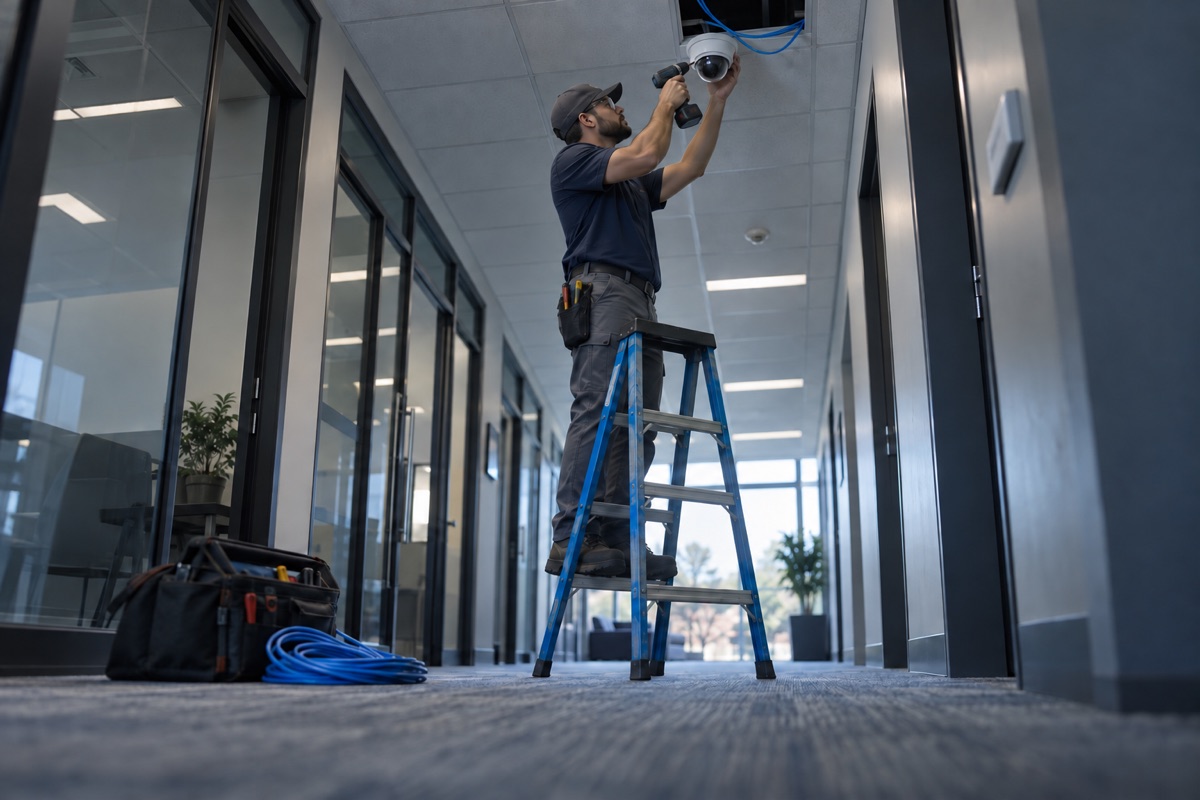
Camera placement designed for the coverage your insurer, state survey, or police partnership expects, mounted and cabled by our own crews, with retention sized to the requirement.
Video intercom & visitor entry
Intercoms at the front door and loading dock that ring a desk or a phone, so a tenant or receptionist can see and admit a visitor.
Cloud & on-premises recording
Cloud-managed cameras where you want nothing to maintain, on-premises recorders where you need long retention or no monthly fee, and a plain comparison before you choose.
License plate & AI detection
Plate capture at gates and lots, people and vehicle detection that cuts false alerts, and on-premises AI detection where footage must stay in the building.
Fire alarm & lock coordination
Electronic locks tied to the fire alarm need the fire department's sign-off in most Metro Detroit cities. We plan around that and coordinate releases with your fire alarm contractor.
Network for security devices
Cameras and controllers on their own VLAN, with PoE switching, battery backup, and bandwidth planned so the security system does not slow the office network or the other way around.
Takeovers & upgrades
Existing systems assessed before anything is replaced. Working cameras and readers stay; dead ones, unsupported recorders, and unknown admin passwords go.
Monitoring & support
Cameras, recorders, and door controllers can roll into a managed agreement, so our NOC sees a camera go offline before you notice the gap in the footage.
In detail
What a security integrator does differently
An alarm company sells monitoring. An electrician pulls wire. A security integrator designs the system around how the building is used, installs the cabling, the devices, and the network they run on, and documents it so the next manager can run it. Because LNX also provides managed IT, the cameras and door controllers sit on a network we understand, with the firmware patched and the admin passwords in your documentation rather than in an installer's head.
How a project runs
We walk the building first: entrances, loading docks, lots, stairwells, and the places staff already worry about. The quote is a fixed written scope with a camera and door schedule, the recording and retention plan, and the permits and fire alarm coordination the city requires. Installation is scheduled around residents, customers, or shifts. Closeout includes labeled drawings, a credential list, and training for the people who will admit visitors and pull footage.
Where the requirements come from
Senior living operators have state survey and resident-safety expectations. Retailers and restaurants have insurance and loss-prevention needs, and in Detroit a Project Green Light partnership with its own camera and bandwidth rules. Warehouses want dock, yard, and plate coverage. Medical offices need access logs. We design to the requirement that applies, and say which one it is.
Who this is for
Property managers, senior living operators, retailers, warehouses, and anyone who has had an incident and no footage.
Every industry we serve pulls on this area differently. Jump to yours to see what it usually looks like.
How engagements run
No mystery scope, no surprise change orders.
- 01
Walk it
We look at the space, the stack, or the drawing set before quoting anything.
- 02
Scope it
A fixed written scope: what is included, what is not, who does what, and when.
- 03
Run it
One project manager owns it end to end and stays your contact after handoff.
Related services
Usually bought together, or one after the other.
Where we work from
Access & Cameras from Troy and Pontiac, Michigan.
Remote support covers any location. On-site work across Metro Detroit is scheduled from the nearer office.
Cloud cameras or a recorder in the building?
Cloud-managed systems have nothing to maintain and a monthly fee per camera. On-premises recorders cost more up front, keep footage in the building, and have no subscription. We quote both for the same camera count so you can see the difference over five years.
Can you take over a system someone else installed?
Yes. We assess what is there, keep what works, and document everything. If the previous installer held the admin passwords, we reset them and put them in your documentation.
Do electronic door locks need a permit?
If the lock is tied to the fire alarm, most Metro Detroit cities require the fire department's sign-off before installation. We confirm which rule applies before quoting. See the Troy and Detroit pages for local specifics.
How long is video kept?
As long as the requirement says. Thirty days is common; some insurers, state surveys, and police partnerships ask for more. Retention sets the storage, and the storage is in the quote.
Do you monitor the cameras?
We monitor the system's health: cameras offline, recorder disk failing, controller unreachable. Live video monitoring by a central station is a separate service we can arrange.
Tell us what's in front of you.
A drawing set, a failing switch, an audit deadline, or a hunch that IT costs too much. We'll tell you who picks it up and what it takes.